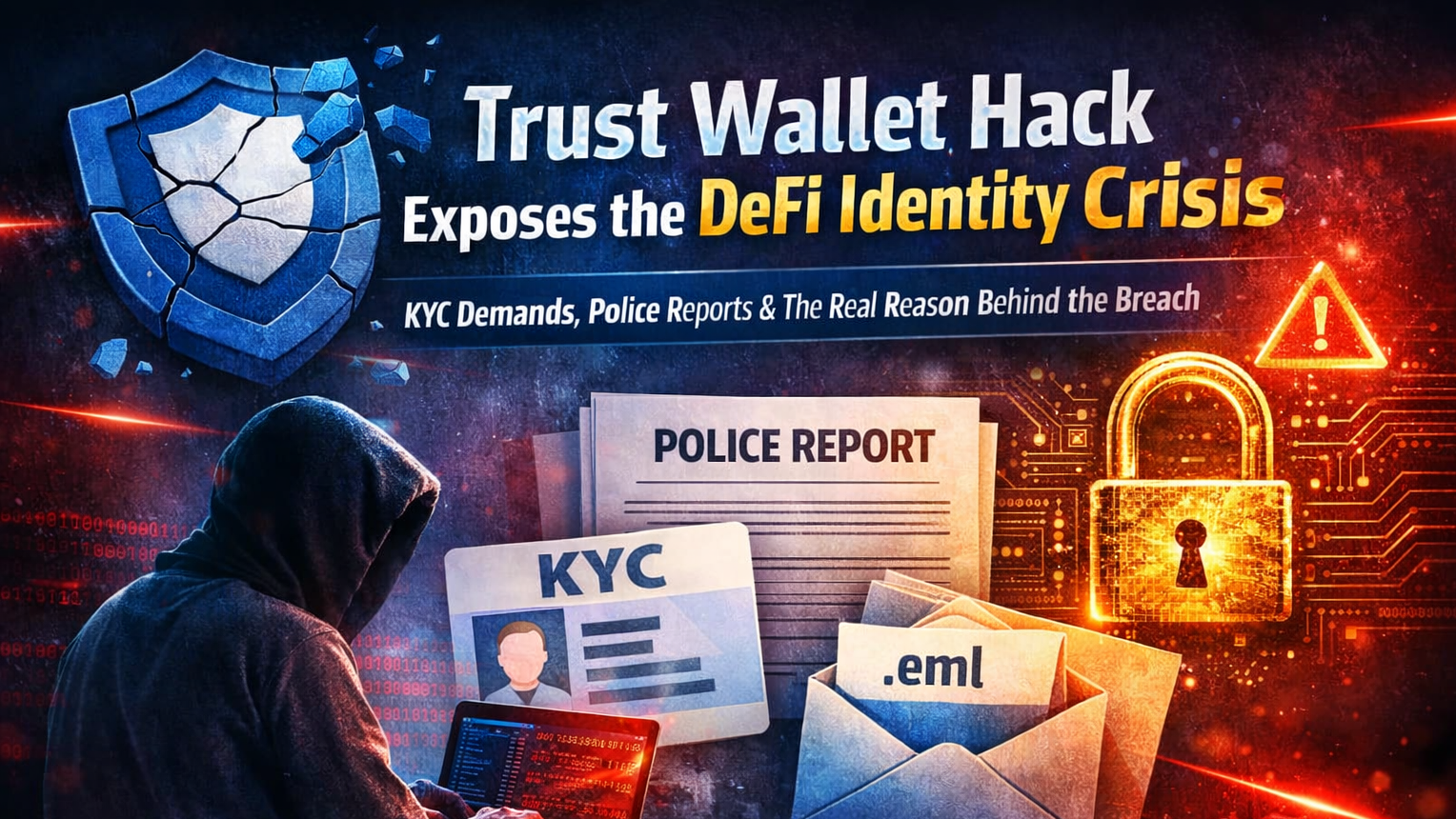
How to Get Hacked Funds Back from Trust Wallet, KYC Procedure, and the Real Reason Behind the Breach
Introduction
The recent Trust Wallet hack has evolved into one of the most controversial incidents in decentralized finance. What began as a technical exploit has now turned into a larger debate about privacy, decentralization, and the future of self-custody wallets.
Users who lost funds are now being asked to submit extensive personal information to receive compensation. This has triggered a wave of confusion, with thousands of users searching online for:
This article explains what actually happened, why users are being asked for KYC, and what this means for DeFi wallets going forward.
What Was the Trust Wallet Hack Reason?
The Trust Wallet hack was not caused by users sharing their seed phrases, clicking phishing links, or approving malicious smart contracts.
Instead, the Trust Wallet hack reason was a vulnerability in wallet infrastructure — meaning the exploit happened at the wallet or connection layer, not the user layer.
This is critical because:
Users did not make mistakes
Private keys were not leaked
Wallets were compromised through software or infrastructure
This makes the incident fundamentally different from normal crypto scams.
Why Victims Were Not at Fault
In most crypto losses, the user signs a bad transaction or reveals their seed phrase. That did not happen here.
The breach allowed attackers to move funds without user approval, which means Trust Wallet’s security systems failed — not the wallet owners.
Yet victims are now being asked to prove their identity and transaction history, as if they were responsible for the loss.
How to Get Hacked Funds Back from Trust Wallet
After the exploit, Trust Wallet launched a compensation and claims process for affected users. To apply, users must submit multiple documents, which has created widespread backlash.
The current process for how to get hacked funds back from Trust Wallet includes:
Submitting a support ticket
Providing full KYC information
Uploading government ID
Sharing exchange deposit and withdrawal history
Providing original email files (.eml format)
Filing a police report in some jurisdictions
This process mirrors centralized exchanges — not decentralized wallets.
What Is the Trust Wallet KYC Procedure?
Although Trust Wallet promotes itself as a non-custodial, no-KYC wallet, the Trust Wallet KYC procedure now applies to anyone requesting compensation.
Users are required to submit:
Passport or government ID
Proof of address
Transaction history from centralized exchanges
Communication logs
Blockchain transaction records
This has created a major contradiction:
Users never provided KYC to use the wallet — but must provide KYC to recover stolen crypto.
Why This Breaks DeFi Principles
Decentralized wallets were built to remove identity requirements.
Ownership in Web3 is proven by cryptography — not paperwork.
A user can prove ownership of a hacked wallet by signing a message from that wallet and pointing to on-chain transactions. That proof is stronger than any passport.
By requiring KYC after a hack, Trust Wallet is shifting from cryptographic verification to bureaucratic control.
This is a dangerous precedent for DeFi.
Can Trust Wallet Be Hacked Again?
One of the biggest concerns raised by this incident is future risk.
If Trust Wallet was breached once due to infrastructure or software vulnerabilities, it can happen again.
Even in a non-custodial wallet, users still depend on:
Browser extensions
RPC servers
Swap routers
API endpoints
Wallet backend services
These systems are centralized points of failure.
Self-custody protects keys — not infrastructure.
Why This Is Not Just a Trust Wallet Problem
This issue extends beyond Trust Wallet.
MetaMask, Phantom, Rabby, and most browser-based wallets operate using similar architectures.
When infrastructure fails, every wallet faces the same problem:
Who pays when users lose funds?
Without on-chain insurance or cryptographic claim systems, wallets fall back to KYC and manual verification — exactly what DeFi was supposed to eliminate.
The Real Web3 Solution
The future of wallet security must move beyond identity checks.
The correct solution includes:
On-chain exploit verification
Wallet-signature based claims
Protocol-level insurance pools
Zero-knowledge identity systems
Automated compensation smart contracts
With this model, users can recover funds without revealing who they are.
That is true decentralization.
Final Thoughts
The Trust Wallet hack did more than expose a technical vulnerability.
It exposed the fragile trust model of modern DeFi wallets.
Users believed they were using decentralized infrastructure.
In reality, they were using centralized systems with decentralized keys.
If KYC is required only when something goes wrong, then decentralization is conditional.
And conditional decentralization is not freedom.