Crypto Exchange Development in 2026: Architecture, Liquidity, Compliance & Cost Realities Founders Don’t Talk About

Crypto Exchange Development Company: Complete Guide to Building a Secure & Scalable Crypto Exchange in 2026

Table of Contents

Most articles on crypto exchange development stop at surface-level explanations.
This one doesn’t.

If you’re reading this, you already know what a crypto exchange is. The real questions now are:

  • Why do most exchanges fail after launch?

  • Where do costs silently explode?

  • Why liquidity integrations break under real traffic?

  • Why “white label” exchanges often hit a scalability wall?

  • What actually differentiates a serious crypto exchange development company from a code vendor?

This guide addresses those exact gaps-based on real-world exchange builds for India, the United States, and global markets.


The Real Core of Crypto Exchange Development: Matching Engine Economics

Forget UI.
Forget token listings.

Your exchange lives or dies by matching engine performance under stress.

What actually matters:

  • Deterministic order matching (price-time priority)

  • Sub-millisecond latency under burst traffic

  • Ability to process 10k–100k TPS spikes

  • Graceful degradation during volatility events

Most off-the-shelf engines fail when:

  • Market makers pull liquidity

  • Order cancellations spike 10x

  • Bots exploit queue latency

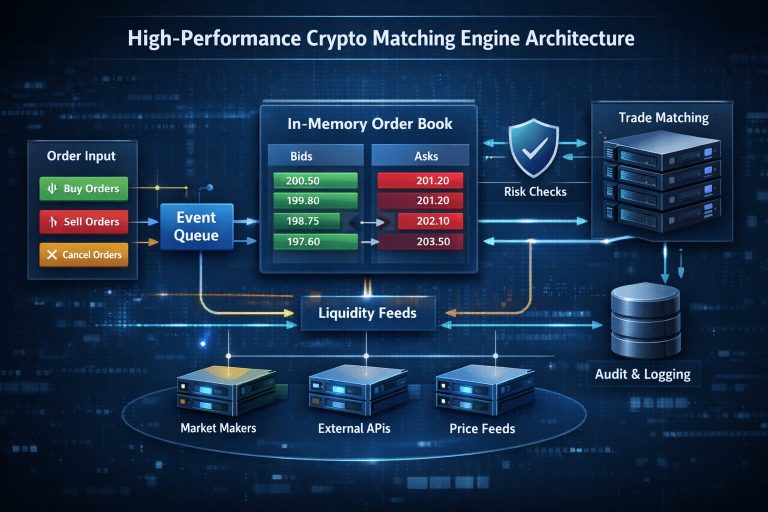
Advanced crypto exchange software development uses:

  • In-memory order books

  • Event-driven architectures

  • Write-ahead logging for recovery

  • Separate risk engines per trading pair

This is where serious engineering budgets go – and where cheap builds collapse.

High-performance crypto matching engine architecture showing in-memory order book, event queue, risk engine, trade matching system, and liquidity providers

Liquidity Is Not an API (And Why Most Integrations Fail)

Liquidity is often misunderstood as a one-time integration.
It isn’t.

Hidden problems exchanges face:

  • Fake depth from shared LP pools

  • Arbitrage draining INR/USDT pairs

  • Latency mismatch between LPs

  • Slippage during volatile markets

Advanced exchanges:

  • Combine external LPs + internal market making

  • Use spread control logic

  • Implement volatility circuit breakers

  • Isolate LP failure from retail order flow

Any crypto exchange development company that promises “deep liquidity in 48 hours” without discussing risk offsets and pair-specific behavior is overselling.


White Label Crypto Exchange Software Development: When It Works-and When It Breaks

White label is not bad.
Blind white label usage is.

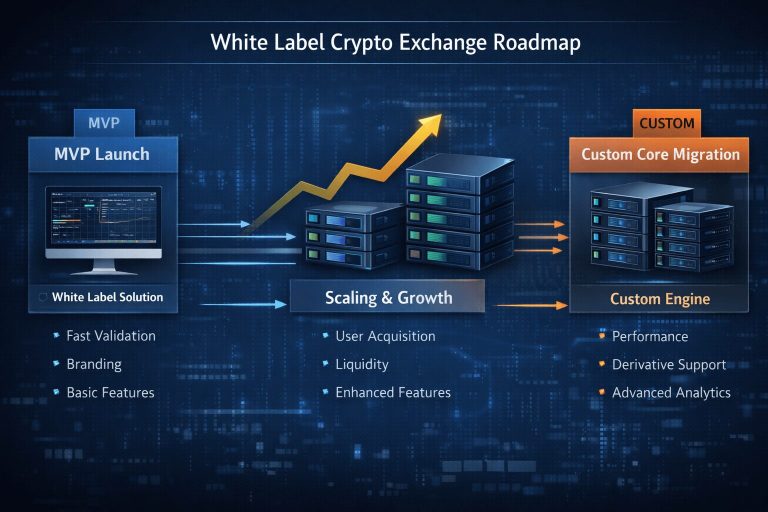
It works if:

  • You launch fast to test market demand

  • You accept architectural constraints

  • You plan a Phase-2 custom engine

It breaks when:

  • Daily active traders exceed ~8–12k

  • You introduce derivatives or P2P

  • You need regulatory-specific flows (US vs India)

  • You require exchange-level analytics

Smart founders use white label as a launchpad-not a permanent foundation.

Crypto Exchange Development Cost: The Truth Behind the Numbers

Most cost estimates online are misleading because they ignore operational complexity.

Real cost drivers founders underestimate:

  • Security audits (ongoing, not one-time)

  • Compliance workflows (manual reviews scale badly)

  • Liquidity risk buffers

  • Cloud cost during volatility spikes

  • Support + fraud response teams

Practical cost ranges (2026 reality)

Component Cost Range
Matching Engine (Custom) $25k–50k
Wallet Infrastructure $10k–20k
White Label Core $35k–70k
Mobile Apps $15k–30k
Security & Audits $10k–25k
Liquidity Setup $5k–20k

A production-grade exchange is rarely under $60k–$120k when done correctly.


Compliance Engineering: Where Most Exchanges Bleed Money

Compliance is not a checkbox—it’s system design.

US-specific realities:

  • KYC workflow branching

  • Suspicious activity monitoring

  • Audit logs that regulators can replay

Reference:
FinCEN MSB Requirements

India-specific realities:

  • INR rails integration

  • Transaction-level traceability

  • FIU reporting structure

Poor compliance design = manual ops = rising costs = stalled growth.


Crypto Exchange App Development: Performance Over Aesthetics

Mobile apps fail when:

  • Web sockets choke under market spikes

  • Order states desync

  • Wallet balances lag

Advanced apps:

  • Use real-time state reconciliation

  • Separate trading & wallet APIs

  • Implement offline-safe order states

  • Support biometric + hardware-backed security

How to Develop a Crypto Exchange That Actually Survives

This is the blueprint experienced founders follow:

  1. Launch with controlled features

  2. Limit pairs initially

  3. Simulate extreme volatility pre-launch

  4. Design for regulatory evolution

  5. Migrate architecture before scaling hurts

Most exchanges don’t fail because of lack of demand.
They fail because the foundation can’t handle success.


Who Should Build Your Exchange (And Who Shouldn’t)

Avoid teams that:

  • Promise “Binance clone in 30 days”

  • Can’t explain order matching logic

  • Don’t ask about liquidity strategy

  • Ignore compliance early

Work with a crypto exchange development company that:

  • Talks in trade-offs, not promises

  • Designs for scaling pain

  • Understands US + India market differences

  • Thinks like an exchange operator-not an agency

How to develop crypto exchanges that scale?

Start with controlled liquidity, isolate core systems, and design for migration before scaling—not after.

How to develop crypto exchange app for high-frequency traders?

Prioritize websocket stability, local caching, and deterministic order state handling.

How much does crypto exchange development really cost?

Expect $60k–$150k+ for a serious platform once security, compliance, and liquidity are accounted for.

Final Insight

In 2026, building a crypto exchange is no longer a tech challenge-it’s a systems engineering and risk management problem.

The difference between exchanges that survive and those that disappear is not features.
It’s architecture, liquidity control, and execution discipline.

Free Crypto Marketing eBook Worth 10k$

Enter your email → Get instant download.

frame image