The phrase “smart contract” once sounded futuristic. Today, it’s fundamental. Whether you are launching a DeFi app, building an NFT marketplace, tokenizing real estate, or managing DAO operations, smart contracts are the invisible engine running everything.
But here’s the decision most founders and enterprise teams wrestle with:
Should you hire a smart contract development company-try building in-house?
This isn’t just a budget decision. It is a strategic one. Selecting the right development model impacts your launch timeline, security posture, tokenomics design, audit readiness, and, most importantly, your return on investment.
In this ROI breakdown, we will walk through what to expect when working with the best smart contract development company, what it costs (both upfront and long-term), and how to evaluate if outsourcing this key infrastructure is actually worth it.
Why Smart Contracts Demand More Than Just Code
At first glance, smart contracts seem simple; they are just code on the blockchain that automates logic. But in reality, they need deep domain knowledge, zero tolerance for bugs, and a deep understanding of:
- Blockchain architecture
- Gas optimization
- Protocol security and reentrancy
- Upgradeability and proxy patterns
- Token standards (ERC-20, ERC-721, ERC-1155, SPL, etc.)
- Integration with dApp front ends, wallets, and oracles
- Compliance needs for certain jurisdictions
One overlooked line of code can lead to exploits, lost funds, or project shutdowns. That’s why even well-funded teams choose to work with a custom smart contract development company instead of handling this in-house.
The True Cost of Building Smart Contracts In-House
Let’s talk numbers. Hiring a full-time blockchain developer in 2026 can cost anywhere between $130,000-$248,000 per year, depending on experience. And even then, it usually takes a small team: an architect, developer, QA engineer, and project manager, to deliver production-ready contracts.
In addition, you’ll need:
- Internal code reviews
- External audits
- DevOps setup
- Post-deployment monitoring tools
- Security failover processes
So while in-house control may seem attractive, the hidden overhead adds up faster, especially if your team doesn’t already have deep blockchain experience.
For many startups and even mid-size enterprises, outsourcing to a smart contract development company becomes the more affordable path.
What You Get When You Hire a Smart Contract Development Company
Not all development partners are created equal. But when you hire a specialized firm, you are not just getting developers; you’re buying maturity, experience, and risk reduction.
Here’s what an export company typically offers:
- Pre-built frameworks to accelerate development
- In-house QA and audit practices
- Access to reusable modules (earnings, stakes, rewards, DAO voting)
- Advice on tokenomics, network selection, and contract structure
- CI/CD pipelines for distribution to test grids and main grids
- Transparent project management and delivery timelines
More importantly, experienced teams help avoid technical debt, which is one of the most costly things a Web3 project can accumulate.
ROI: What You Actually Gain by Outsourcing
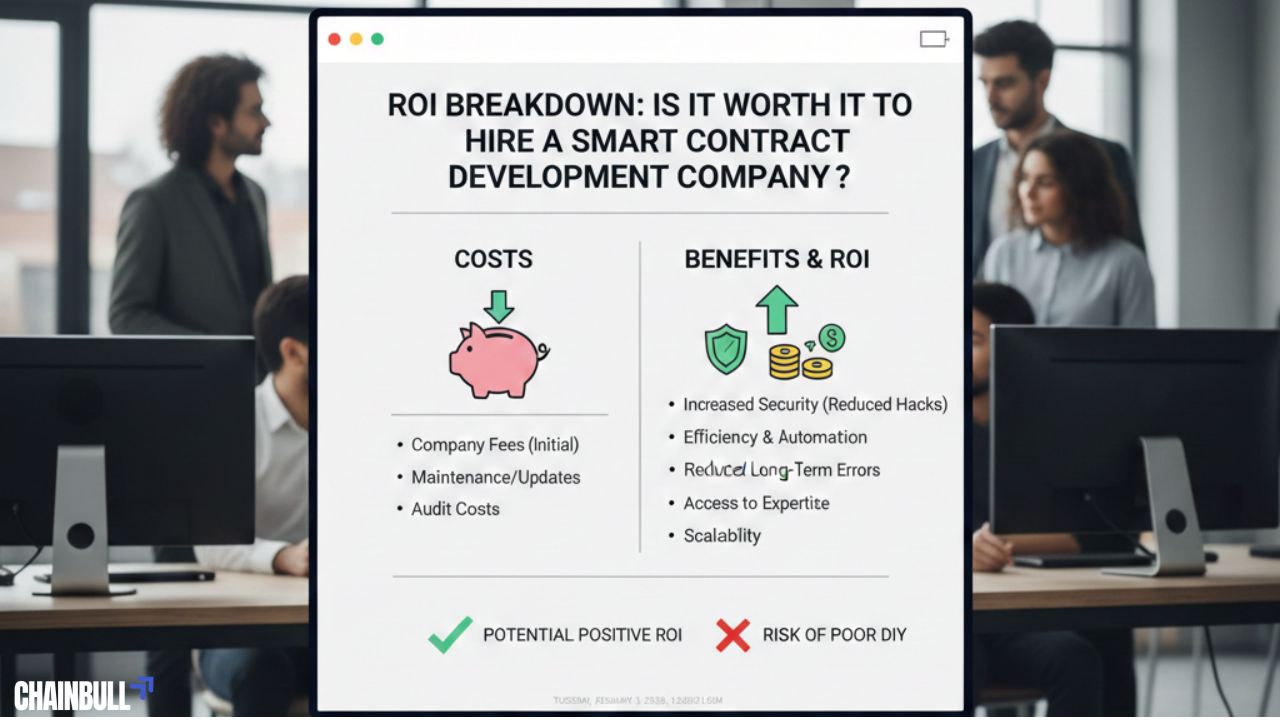
Let’s break down the return on investment from working with a smart contract development company.
Time to Market
A specialized firm can simply ship production-ready contracts in 2-6 weeks, depending on the complication. In contrast, internal teams can take 2-3x longer when navigating the unknowns. Faster launches mean you begin generating revenue and traction earlier.
Security Confidence
Reputable companies often follow the audit-grade practices from day one. This simply means your contracts are more likely to pass audits smoothly. This reduces the need for expensive post-launch fixes or emergency patches.
Long-Term Flexibility
Good smart contract architectures are modular. That simply means your future features, tokens, or integrations won’t require full contract rewrites, saving you time and dev costs down the road.
Strategic Support
Many teams offer consultative input on more than just code. They help align the smart contract logic with your product objectives, go-to-market strategy, and token utility, giving you more than development, but also crypto-native product thinking.
If you are balancing this against a full-time hire or team expansion, the math becomes clear faster.
Enterprise vs. Startup: Who Should You Hire?
If you are a new project or working on one, your needs will be different from a corporation integrating blockchain into an existing tech stack. That is why many top firms differentiate between enterprise smart contract development company services and those designed for Web3-native startups.
Startups often need:
- MVP token contracts
- Token vesting and distribution
- Staking logic
- Basic DAO governance
- DEX listing support
Enterprises typically need:
- Compliance-heavy contracts
- Multi-singature control logic
- Custom privacy layers
- Integration with legacy systems
- Full documentation and auditing support
Knowing which firm aligns with your requirement is half the battle.
Signs You’ve Found the Right Partner
So how do you know you are working with the best smart contract development company and not just an agency repurposing Web2 developers?
Look for these signs:
- They have deployed a live contract on the mainnet – not just a testnet or hackathon
- Their smart contract logic has passed independent audits (ask for report).
- They use frameworks like Hardt, Foundry, or Anchor fluently
- They offer versioning and upgrade logic (Proxy Pattern, Upgradable Contracts).
- They are comfortable integrating with Oracles, Bridges,s and L2s
It is also a good sign if they have written public-facing content, and it shows thought leadership.
Potential Risks of Cutting Corners
Too many teams still treat smart contract development like a feature, not a foundation. And the costs of that mindset can be devastating.
Here’s what we can go wrong with the low-quality work:
- Logic bugs that lock the full funds
- Failed audits that delay the launch of tokens
- Damage to reputations from exploited contracts
- Blacklisted by launchpads, exchanges, or communities
- Token inflation due to miswritten minting logic
In Web3, mistakes are public, permanent, and expensive. The best way to neglect them is to start with a team that knows how to build for scale, security, and trust.
Verdict: Is It Worth It?
Yes, if you choose the right team.
Hiring a skilled and reliable custom smart contract development company offers you a shortcut to experience, reliability, and faster growth. It removes the guesswork from a highly technical, high-stakes part of your project and replaces it with proven systems.
At Chainbull, we’ve worked with DeFi startups, NFT marketplaces, RWA platforms, and DAOs to build safe, scalable, and upgrade-ready smart contracts tailored to product requirements. Whether you are a founder looking for a quick launch or a company in need of a deeply integrated smart contract development company for startups, we bring full-stack thinking to every engagement.