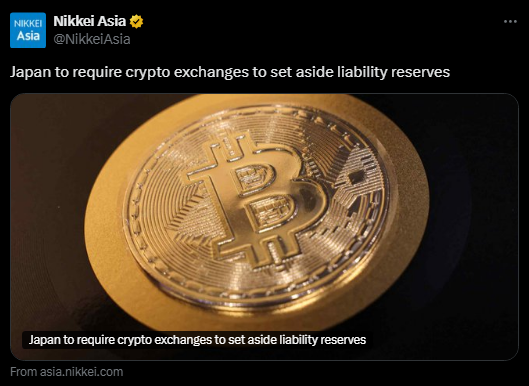
It is reported that Japan’s Financial Services Agency is planning new regulations that would impose on domestic cryptocurrency exchanges the requirement to have an emergency reserve fund to cover the losses resulting from incidents such as a hack or a security breach. This action is designed to raise the level of investor protection in a sector that has been repeatedly disrupted and that has had several security breaches. The introduction of the provision was triggered by the concern that the current safeguards are insufficient to protect customers in cases when exchanges suffer operational failures or exploit-driven losses. As per the existing regulations, Japan mandates that exchanges keep the crypto assets of customers in cold wallets, thus, funds are kept separately from the internal operational holdings. Nevertheless, they are not presently required to set aside special funds to make up for the users if a security breach happens. The Financial Services Agency intends to step in to fill this regulatory void by formally requiring that reserves be managed in connection with liabilities and exchange operations.
FSA Preparing Bill for Submission in 2026 Parliamentary Session
The reform is in line with Japan’s long-term strategy to enhance the supervision of digital assets, especially after the domestic exchange breaches. The new compliance requirements will be imposed on any platform that offers crypto trading services in Japan. That means foreign-operated exchanges serving the market via local licenses will also be subject to these requirements.
At the beginning of this month, it was also reported that officials were considering the imposition of a new condition that requires trading partners and third-party custodians working with local exchanges to obtain regulatory permission before providing services. That proposal is likewise expected to be presented during the 2026 ordinary Diet session, and the oversight scope will be expanded beyond the primary exchange operators to the firms that take care of the delegated custody and technical trading infrastructure.
Major Hack in 2024 Led to Faster Regulatory Focus on Risk Management
The regulatory momentum is largely due to the 2024 hack of DMM Bitcoin, a Japanese exchange that was estimated to have lost about $312 million. Inquiries revealed that the break-in was related to Ginco, a software company based in Tokyo, that DMM had outsourced for its trading management systems. The event has deepened the focus on the operational frameworks that are outsourced and has moved the whole sector faster to the implementation of financial accountability requirements. Apart from protections against hacks, the reserve requirements are also an element of Japan’s comprehensive digital asset policy plan. The Financial Services Agency is pondering over whether to reclassify cryptocurrencies under the Financial Instruments and Exchange Act instead of the Payment Services Act. The change would be consistent with treating crypto as a financial instrument subject to regulation and may enable the tax rate of crypto to be in line with other asset classes, such as stocks and bonds, at a flat rate of 20%.
Japan Moves Industry Rulemaking Forward as Market Developments Speed Up
Additionally, Japan has enacted measures addressing stablecoins. Regulators gave their blessing to the jointly yen-backed stablecoin project by three leading Japanese banks thus demonstrating their long-term trust in the integration of the regulated fiat-pegged assets into the national financial system. At the same time, top institutions are deliberating on the launch of new crypto-based investment products. On Monday, Nikkei reported that six prominent wealth managers, including Mitsubishi UFJ Asset Management and Daiwa Asset Management, are collaborating to launch the first crypto investment trusts in Japan, which is a clear indication of institutional engagement in the evolving market.
Stay Ahead with Chainbull
Crypto evolves every second—make sure you don’t miss a beat. Visit Chainbull for expert insights, detailed market breakdowns, and trusted updates from the world of blockchain and digital assets.
Sophia Bennett is a tech-focused content strategist and copywriter specializing in Web3 & blockchain. She helps startups and enterprise brands craft high-conversion content that connects deep technology with real business outcomes. With a strong focus on clarity, credibility, and engagement, Sophia transforms complex innovations into powerful narratives that build trust, drive growth, and strengthen digital presence in the evolving tech ecosystem.