
Tokens on a blockchain are not random pieces of code; they follow the shared technical rules so that wallets, custody systems, custodians, and trading portals can understand how they actually behave. These rules are simply called token standards. Without them, blockchain would function like isolated islands, and applications would not know how to store, move, or record the digital value.
This is because property investment needs legal accuracy, token standards that are a core requirement when building digital ownership systems. As real estate tokenization expands across fund structures, registry programs, and fractional participation, standards help align technical behavior with ownership rights. Similarly, this logic supports digital assets tokenization, where ownership units rely on predictable behavior.
This article simply explains how token standards affect the digital property, reviews major Ethereum-based formats, compares their design choices, and identifies how each standard simply fits inside regulated capital systems. The focus remains practical: what each standard does, how it is used, and where it fits in property-based financial activity.
Before moving toward the in-depth details of the token standards, we need to understand their core. Token standards define how smart contracts manage balances, rights, and transfer functions. They outline which commands are actually allowed, how ownership records are stored, and how different software systems communicate. This matters in property because investors expect exact records and verified transfers.
Traditional real estate investment needs multiple layers of paperwork and supervision. When it comes to a normal property sale, it might include title offices, land registries, lawyers, lenders, escrow accounts, and multiple signatures. Token standards simply allow part of this flow to be dealt with digitally. A smart contract can record the transfer, update the unit count, and publish an audit trail visible to all participants.
Not only this, but token standards also support liquidity. When a token follows a known technical format, trading platforms can connect without designing a new integration path. This is because liquidity depends on compatibility; token standards encourage broader participation. In property finance, this helps investors enter and exit positions more easily than in traditional private trusts.
Now, another perk is record-keeping. Property investments rely on compliance reporting and identity requirements. Standards do not replace regulation, yet they structure how technical records align with legal duties.
Token models fall into three broad groups. Fungible tokens work like divisible financial shares. They enable many participants to pool ownership. This works for rental pools or building funds.
Non-fungible tokens create unique records. Each token has a separate identity. This fits property titles or parcels.
Hybrid systems let developers issue multiple units under one framework. They can represent the equity, debt, or income claims in the same contract. This reduces operational overhead.
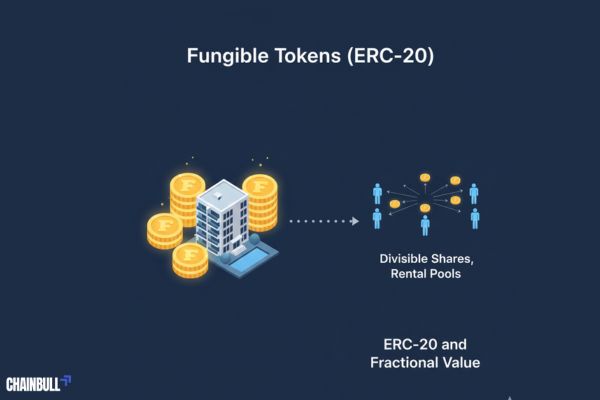
ERC-20 is a fungible standard used for tokens where each unit behaves like every other unit. It controls balances, transfer commands, and spending allowances. ERC-20 supports fractional ownership, making it useful for pooled property interests.
Investors understand ERC-20 because it is integrated with the majority of wallets and custodians. Exchanges already support price tracking and order flow for this standard. When a property project wants to issue 10,000 identical units, ERC-20 can manage supply and transfer predictably.
However, ERC-20 no longer supports compliance policies on its own. It does not recognize whether a holder is certified to invest. It can not save you from restricted transfers. Property assets frequently fall below regulated capital regulations, so ERC-20 may additionally require identity layers or permission tests outside the agreement.
ERC-721 was developed for non-fungible assets where each unit is distinct. A token can represent a parcel of land, a building title, or a specific apartment. A blockchain can store metadata that points to documents or registry references.
This makes sense for properties because no two parcels share the same rights. A 700-square-foot unit on the 12th floor is not the same as a 2,000-square-foot unit on the ground level. ERC-721 records this difference at the token level.
Fractionation under ERC-721 is difficult. To divide ownership, issuers must create a wrapper or trust. ERC-721 shines when tracking a single ownership claim, such as a deed. Investors must still comply with off-chain registry rules.
ERC-1155 supports both fungible and non-fungible units inside the same contract. It means a building can have a single unique title and many fungible income shares without deploying multiple contracts.
This works extremely well when a developer wants to raise capital across equity and debt instruments. It supports batch transfers, too, which can reduce the transaction costs for custodians.
Institutional adoption depends on tooling. Wallets and custodians must support ERC-1155 for it to be deployed at scale.
ERC-1400 was created for restricted assets. It simply contains hooks for identity checks and restricted transfers. These controls help project structure investor groups, enforce holding conditions, and assign restrictions.
Property securities often need accreditation checks, regional limits, or lock periods. ERC-1400 supports these mechanics through partitions and transfer controllers. It doesn’t replace legal documentation, but it streamlines technical models with supervised environments.
Check out the comparison, showing how these standards differ.
Feature | ERC-20 | ERC-721 | ERC-155 | ERC-1400 |
Fungibility | Yes | No | Mixed | Yes |
Fractional Ownership | Stong | Weak | Medium | Strong |
Compliance Controls | None | None | Limited | Strong |
Identity Gating | External Only | External Only | Optional | Built-in |
Exchange Support | High | Medium | Medium | Controlled |
Best Use-Case | Ownership Units | Titles | Mixed uses | Regulated Securities |
ERC-3643 focuses on identity-based token transfers. It connects wallet eligibility to KYC requirements. In simple terms, a wallet must satisfy KYC checks before it can hold or receive tokens. This supports regulated offerings where investor qualification is mandatory.
This standard supports semi-fungible concepts. It works for financial products where values share characteristics but need distinctions, such as a loan tranche or structured note.
This vault-accounting standard clarifies how yield-bearing assets calculate deposits and withdrawals. Property funds that distribute income can use this structure for precise accounting.
These additions show that standardization continues to evolve. Token engineering is not static. As legal frameworks mature, technical templates will follow.
Which Standard Fits Which Property Scenario
Property Scenario | Recommended Standard | Reason |
Single property deed | ERC-721 | One asset, one owner |
1,000 fractional investors | ERC- 20 | Divisible units |
Multi-share capital raise | ERC-1155 | One contract, many variants |
Regulated fundraising | ERC-1400 | Permission rules |
Investor KYC enforced | ERC-3643 | Wallet identity binding |
Property models differ across legal and financial functions. Some include a direct title. Others manage pooled income. Some need regulatory authorization. Technical decisions follow those needs.
A unique title corresponds to one token. ERC-721 can store metadata for parcel identifiers. These layers may be linked through ERC-3643 if needed.
Divisible models work best with ERC-20 and align with ownership units. One building (ERC-1155) can support tens of thousands of holders without changing the token structure.
Yield-bearing assets may get an advantage from ERC-20 and ERC-4626 because these standards handle the unit balances and revenue calculation.
Investor permissioning is supported through ERC-1400 and identity-based controls. Compliance is easier when the token standard recognizes restriction rules. Adding these checks supports digital asset tokenization when regulatory approval is needed.
Use-Case Table
Requirement | Best fit |
Unique parcel | ERC-721 |
Fractional access | ERC-20 |
Multiple share classes | ERC-1155 |
Permissioned securities | ERC-1400 |
Identity control | ERC-3643 |
Yield accounting | ERC-4626 |
No single standard meets every rule. Property spans law, accounting, and settlement obligations. Tokens help structure records, not legal outcomes.
Question : Why It Matters
Is the asset regulated? Determines compliance needs
Do you need fractional access? Guides fungible vs non-fungible
Will investors be retail or accredited? Impacts identity gating
Is exchange liquidity important? Shapes ERC-20 suitability
Will you manage multiple investor classes? Points to ERC-1155
Are transfers restricted by law? Suggests ERC-1400 family
These are the practical, measurable advantages rather than sales claims.
Token standards cannot override these needs.
Property rights are enforced by courts and registries. Token contracts can record ownership changes, but legal recognition still depends on state authority. KYC and AML checks also need supervision.
Standards help encode transfer rules, but compliance layers must confirm identity and qualification. These checks cannot be bypassed by software logic. Legal teams must approve distribution frameworks.
Before using token standards, platforms must manage fundamental infrastructure. They require custody support, identity verification, and investor dashboards. Wallet management must be safe enough to protect ownership proofs. Investors expect identity controls, reporting dashboards, and income tracking.
These systems also interact with traditional reporting. Property managers still issue financial statements. Tokens can mirror these flows, but underlying records must be auditable. Without operational support, token formats will not matter.
Real-Estate Product | Token Type | Why |
Rental building fund | ERC-20 | Tracks fractional income |
Private REIT | ERC-1400 | Investor permission classes |
Loan-backed tranche | ERC-3525 | Distinct yield claims |
Construction financing | ERC-1155 | Debt and equity inside one issue |
Single home title | ERC-721 | Unique property record |
Therefore, these categories show how standards support different financial models.
Some commentary claims that tokens make property liquid or eliminate risk. That is inaccurate. Property does not work that way. Liquidity depends on market-maker interest, regulatory approval, tenant behavior, construction timelines, interest-rate exposure, and investor demand. Token standards help with accounting and transfer consistency. They do not change risk.
Risk remains tied to real-estate fundamentals: income variability, maintenance costs, and financing conditions. A token cannot alter these drivers. It can only record how ownership behaves.
Choosing a standard should be based on functional needs, not marketing language. ERC-20 helps fractional access. ERC-721 supports unique rights. ERC-1155 reduces contract overhead. ERC-1400 and identity-gated systems help meet compliance. Each standard fits a specific purpose.
Token standards guide how blockchain networks interpret ownership, qualification, and settlement controls. They do not remove regulation or business risk. They ensure consistent behavior between wallets, custodians, and trading venues. As real estate tokenization continues to support private placements and fractional models, organizations will select standards based on functionality rather than marketing narratives.
Chainbull helps companies communicate clearly in the digital asset market. The firm supports investor education, messaging accuracy and industry positioning so property teams approach tokenization with realistic expectations and structured plans.